

USB Devices Market Reaches USD 141.14 Billion at 13.70% CAGR By 2035
USB Devices Market
USB Devices Market Size, Share and Research Report By Product (USB Flash Drives, Digital Audio Players, Computer Peripherals, USB Hubs and Docks
USB Devices Market continues to grow as consumers and businesses demand reliable connectivity, high-speed data transfer, charging solutions, and versatile peripheral devices.”
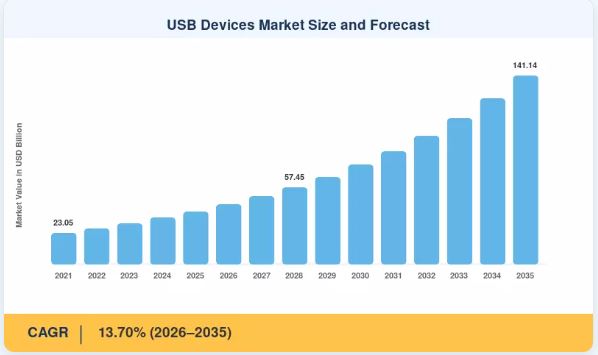
PARIS, PARIS, FRANCE, September 22, 2026 /EINPresswire.com/ -- The USB Devices Market reached USD 39.09 billion in 2025 and is projected to open the forecast period at USD 44.44 billion in 2026, before reaching USD 141.14 billion by 2035 at a 13.70% CAGR. The market is benefiting from increasing demand for high-speed connectivity, portable storage, charging, peripheral expansion, and multi-device compatibility. USB technology continues to remain essential across consumer, enterprise, automotive, healthcare, industrial, and telecommunications applications.— Market Research Future (MRFR)
Asia-Pacific dominates the USB Devices Market with 48.6% of 2025 revenue, supported by major electronics assembly and manufacturing clusters across Shenzhen, Penang, and Ho Chi Minh City. The Middle East & Africa region is expected to record the fastest growth at a 14.05% CAGR as smartphone penetration, digital connectivity, and electronic device adoption increase. North America ranks second with a 21.4% share, supported by enterprise hardware refresh cycles, hybrid-work infrastructure, docking requirements, and demand for advanced connectivity accessories.
➤ USB Devices Technology Evolution
USB devices have evolved from basic computer peripherals into multifunctional connectivity solutions supporting data transfer, charging, video output, storage, networking, and device expansion. The transition from older USB standards toward USB 3.x, USB4, and USB-C is increasing performance and functionality across modern electronics. USB-C is particularly important because its reversible connector and ability to support high-speed data, power delivery, and alternate-mode video make it suitable for smartphones, tablets, laptops, displays, and other connected devices.
Get Full PDF Sample Copy of Report: (Including Full TOC, List of Tables & Figures, Chart) @
https://www.marketresearchfuture.com/sample_request/8671
➤ Who Are the Key Players in the USB Devices Market?
• Samsung Electronics
• Western Digital (SanDisk)
• Kingston Technology
• Logitech International
• Anker Innovations
• Belkin International
• Lexar (Longsys)
• Transcend Information
• Targus
• Dell Technologies
• HP Inc.
➤ Key Market Drivers:
Rising adoption of smartphones, laptops, tablets, gaming systems, smart electronics, and connected devices is creating sustained demand for USB-based connectivity solutions. Consumers and businesses increasingly require reliable accessories for transferring data, connecting peripherals, charging devices, and expanding limited device ports. The growth of hybrid work is also supporting demand for webcams, hubs, adapters, and docking stations. USB devices remain attractive because they provide convenient plug-and-play connectivity across a wide range of electronic systems.
➤ USB-C Adoption:
USB-C is becoming one of the most important growth areas within the USB Devices Market as manufacturers increasingly use the connector across modern electronics. Its reversible design improves user convenience, while support for high-speed data transfer, charging, and video connectivity allows a single interface to serve multiple functions. Regulatory initiatives promoting common charging interfaces are also accelerating the transition toward USB-C. As more smartphones, laptops, tablets, and other products adopt the standard, demand for compatible cables, adapters, hubs, and peripherals is expected to increase.
➤ USB Flash Drives and Storage:
USB flash drives remain an important product category because they provide portable, affordable, and convenient data storage. Consumers, students, businesses, media professionals, and government organizations continue to use flash drives for transferring files, backups, offline storage, and secure data movement. At the same time, higher-capacity external SSDs and USB4-compatible storage solutions are expanding opportunities for users requiring faster transfer speeds and greater storage capacity. The combination of portability, affordability, and increasing storage capabilities continues to support demand.
➤ USB Hubs and Docking Stations:
USB hubs and docking stations are gaining importance as laptops and other compact devices increasingly offer fewer physical ports. These products allow users to connect multiple peripherals through a single interface, including monitors, keyboards, mice, storage devices, Ethernet connections, memory cards, and other accessories. Hybrid work and flexible office environments are further supporting demand because employees often require consistent connectivity across home and corporate workspaces. Hubs and docking stations are therefore becoming important productivity accessories for modern computing environments.
Get access to the full description of the report @
https://www.marketresearchfuture.com/reports/usb-devices-market-8671
➤ Consumer Electronics Applications:
Consumer electronics represents a major application area for USB devices, covering smartphones, laptops, tablets, gaming systems, wearable devices, digital cameras, and home entertainment equipment. USB connectivity supports charging, data synchronization, peripheral connections, and external storage across these products. Increasing device ownership and frequent upgrades are sustaining demand for USB accessories. The expansion of high-resolution content, gaming, mobile computing, and connected lifestyles is also encouraging consumers to adopt higher-speed USB products.
➤ Enterprise and IT Applications:
Enterprises rely on USB devices for workstation connectivity, peripheral management, data transfer, system configuration, storage, and device deployment. Businesses adopting hybrid work models increasingly require docking stations, webcams, hubs, external storage, and other USB accessories to support flexible work environments. IT departments also use USB interfaces for system maintenance, firmware updates, device configuration, and troubleshooting. As organizations modernize their computing infrastructure, demand for reliable and secure USB connectivity solutions is expected to remain strong.
➤ Automotive Opportunities:
Automotive applications represent an increasingly important growth area as vehicles become more connected and digitally integrated. USB ports are widely used for smartphone connectivity, charging, infotainment, media access, and passenger-device integration. Electric vehicles and software-defined vehicles are adding more digital functions, increasing the importance of reliable high-speed connectivity inside the vehicle. USB-C ports with higher power delivery capabilities are particularly relevant for modern automotive interiors, where passengers expect convenient charging and seamless integration with personal electronics.
➤ Industrial Applications
Industrial environments use USB devices for equipment configuration, data collection, machine connectivity, diagnostics, firmware updates, and automation systems. Ruggedized USB connectors and hubs can provide connectivity in environments where equipment may experience vibration, dust, temperature variations, or continuous operation. Industrial digitalization and the adoption of connected machinery are creating additional opportunities for USB-based interfaces. As factories increasingly deploy sensors, automation equipment, and industrial computers, demand for dependable connectivity solutions is expected to expand.
➤ Healthcare and Medical Devices
USB connectivity is also becoming valuable across healthcare and medical equipment because it enables convenient data transfer and communication between diagnostic devices, computers, displays, and other systems. USB interfaces can support portable medical equipment, monitoring systems, imaging peripherals, and data-transfer applications. The expansion of connected healthcare equipment and digital patient-management systems is creating new opportunities for specialized USB devices. Reliability, data security, durability, and compatibility remain important considerations when USB technologies are deployed in healthcare environments.
➤ Gaming and Multimedia Demand
Gaming and multimedia applications are generating demand for high-performance USB peripherals, including keyboards, mice, headsets, webcams, controllers, external storage, and docking solutions. Gamers increasingly prioritize low latency, fast data transfer, high polling rates, and reliable connectivity. Content creators similarly require high-speed interfaces for cameras, microphones, storage drives, displays, and other equipment. USB 3.x and USB4 technologies can support these demanding applications by providing greater bandwidth and improved connectivity capabilities.
➤ Market Challenges:
Despite strong growth prospects, the USB Devices Market faces challenges related to compatibility, product quality, cybersecurity, connector durability, pricing, and technology fragmentation. Consumers may encounter differences in charging capabilities, data-transfer speeds, device compatibility, and power-delivery specifications across products. Manufacturers must also maintain signal integrity and thermal performance as USB devices become faster and more compact. Certification requirements and the need to support multiple operating environments can add complexity to product development and manufacturing.
Buy Full Research Report:
https://www.marketresearchfuture.com/checkout?currency=one_user-USD&report_id=8671
➤ Competitive Landscape:
The competitive environment includes semiconductor companies, electronics manufacturers, storage-device providers, peripheral brands, accessory manufacturers, and specialized connectivity developers. Competition increasingly focuses on data-transfer speeds, power delivery, compatibility, durability, compact designs, security, and multifunctionality. Manufacturers are also expanding product portfolios around USB-C, USB4, high-capacity storage, multi-port hubs, docking stations, and specialized industrial solutions. Product differentiation and the ability to meet evolving connectivity standards will remain important competitive factors.
➤ Future Market Outlook:
The future outlook for the USB Devices Market remains positive as digital devices continue to expand across consumer, enterprise, automotive, healthcare, industrial, and telecommunications environments. The projected increase from USD 39.09 billion in 2025 to USD 141.14 billion by 2035 demonstrates the significant long-term opportunity. USB-C adoption, high-speed data transfer, hybrid work, portable storage, automotive connectivity, and multifunctional docking solutions are expected to remain important growth catalysts. Continued technology development should further strengthen the role of USB devices in connected digital ecosystems.
➤ Emerging Opportunities:
Emerging opportunities are concentrated around USB-C accessories, USB4 devices, high-speed external storage, advanced docking stations, automotive connectivity, industrial USB solutions, and intelligent peripherals. Demand for compact products capable of combining charging, data, networking, and display connectivity is expected to increase as device manufacturers reduce physical ports. The continued expansion of cloud computing, gaming, content creation, artificial intelligence, edge computing, and connected devices will also create additional requirements for high-performance data-transfer and connectivity solutions.
➤ Frequently Asked Questions:
What is the USB Devices Market?
The USB Devices Market covers USB-enabled storage products, peripherals, hubs, docking stations, adapters, connectors, and other connectivity solutions.
What is driving the USB Devices Market?
Rising device adoption, USB-C migration, high-speed data transfer, charging requirements, hybrid work, and demand for peripheral connectivity are key drivers.
What will the market size be by 2035?
The USB Devices Market is projected to reach approximately USD 141.14 billion by 2035.
What is the expected CAGR?
The market is projected to grow at approximately 13.70% CAGR during the forecast period.
Which region dominates the USB Devices Market?
Asia-Pacific leads the market with approximately 48.6% of 2025 revenue.
Which region is growing fastest?
The Middle East & Africa region is projected to grow fastest at approximately 14.05% CAGR.
Why is USB-C important?
USB-C combines reversible connectivity with high-speed data transfer, power delivery, and support for multiple functions.
What are major USB device applications?
Major applications include consumer electronics, IT and telecommunications, automotive, healthcare, industrial systems, gaming, and enterprise computing.
What are major market challenges?
Compatibility, certification, product quality, technology fragmentation, cybersecurity, and connector durability are key challenges.
What is the future of USB devices?
USB devices are expected to expand through USB-C, USB4, advanced storage, docking systems, automotive connectivity, and high-performance peripherals.
➤➤➤ Regional & Country-Level Reports by Market Research Future:
US USB Devices Market:
https://www.marketresearchfuture.com/reports/us-usb-devices-market-16508
➤➤➤ Industry Analysis Reports by Market Research Future:
Market Research Future
Market Research Future
+ +1 855-661-4441
email us here
Legal Disclaimer:
EIN Presswire provides this news content "as is" without warranty of any kind. We do not accept any responsibility or liability for the accuracy, content, images, videos, licenses, completeness, legality, or reliability of the information contained in this article. If you have any complaints or copyright issues related to this article, kindly contact the author above.
