

Interactive Display Market to Witness Steady Growth, Reaching USD 105.60 Billion by the End of 2035
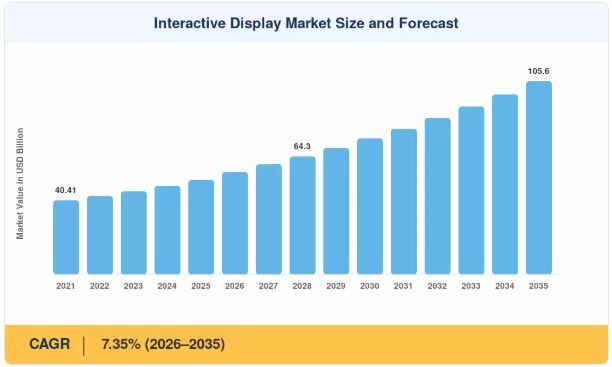
Interactive Display Market
Interactive Display Market Size, Share and Research Report By Display Type (Interactive Flat Panel, Interactive Kiosk, Interactive Video Wall, Interactive)
Interactive Display Market: Growing adoption of interactive displays in education, corporate, retail, and healthcare environments is transforming digital engagement and collaboration.”
BERLIN, BERLIN, GERMANY, September 22, 2026 /EINPresswire.com/ -- ➤ Market Overview— Market Research Future (MRFR)
The Interactive Display Market closed 2024 at USD 33.04 billion and enters the forecast window at USD 36.03 billion in 2025, climbing to USD 85.48 billion by 2035 at a 9.03% CAGR. This expansion reflects rising demand for touch-enabled collaboration tools, smart classroom technology, digital signage, and immersive customer engagement platforms across education, corporate, retail, healthcare, and public-infrastructure settings.
North America commanded 32.6% of the Interactive Display Market in 2024, supported by early adoption of smart classroom technology, mature corporate collaboration budgets, and strong demand for interactive kiosks across retail and healthcare environments. Institutions and enterprises are increasingly replacing static displays and traditional whiteboards with touch-enabled panels to improve engagement, accessibility, and operational efficiency.
Asia-Pacific is advancing at an 11.4% CAGR across the forecast period, making it one of the fastest-growing regions for interactive display technology. Large-scale education modernization programs, expanding retail and hospitality infrastructure, rising disposable incomes, and growing domestic display manufacturing capacity are creating substantial opportunities for suppliers throughout the region.
The Middle East & Africa reached USD 1.87 billion in 2024, supported by smart-city initiatives and increasing investment in digital public infrastructure. Governments and enterprises are focusing on interactive wayfinding, digital classrooms, and public-sector kiosks, creating additional demand for interactive display hardware and supporting software platforms.
Download Sample Pages of Research Overview -
https://www.marketresearchfuture.com/sample_request/8042
➤ Interactive Display Industry Landscape
Interactive displays combine touch, gesture, or stylus-based input with large-format screens, allowing users to engage directly with digital content rather than passively viewing it. Instead of relying on static monitors or printed signage, organizations are deploying interactive kiosks, video walls, whiteboards, tables, and flat-panel displays that support real-time collaboration, content sharing, and data-driven customer engagement.
The growing complexity of hybrid classrooms and hybrid workplaces is strengthening demand for these solutions. Organizations increasingly need displays that integrate with cloud-based content management systems, video conferencing platforms, and analytics tools, creating opportunities for hardware manufacturers, software providers, and systems integrators that can deliver connected, easy-to-manage interactive ecosystems.
➤ Digital Signage Market
The Digital Signage Market is a relevant topical authority keyword because digital signage networks increasingly rely on interactive touch technology, cloud-based content management, real-time analytics, and connected display hardware. Interactive capabilities allow signage operators to move beyond one-way broadcast content toward two-way engagement, wayfinding, and personalized messaging.
The connection between digital signage and interactive displays demonstrates how touch-enabled hardware is becoming fundamental to modern digital engagement strategies. As retailers, transportation hubs, and public institutions deploy connected signage networks, they require displays that can support interactivity, secure remote management, and integration with broader content and data platforms. These requirements create opportunities for interactive display providers across retail, transportation, and public-sector technology ecosystems.
➤ Key Growth Drivers
The rapid shift toward digital learning and hybrid work remains a major growth driver for the market. Educational institutions and enterprises are replacing traditional whiteboards, projectors, and static monitors with interactive flat-panel displays to support real-time collaboration, remote participation, and engaging content delivery. This transition is encouraging vendors to expand product portfolios across panel sizes, resolutions, and price points.
Retail and customer-experience investment is another significant factor supporting industry expansion. Interactive kiosks, video walls, and touch tables allow retailers, hospitality operators, and transportation hubs to deliver self-service options, personalized promotions, and wayfinding assistance, reducing staffing pressure while improving customer satisfaction and dwell time.
➤ Education and Corporate Collaboration Adoption
Interactive whiteboards and flat-panel displays are becoming standard equipment in classrooms and training environments as institutions modernize teaching methods. Displays that support annotation, screen sharing, and integration with learning management systems help improve student engagement and accommodate hybrid or remote learners.
Corporate collaboration is following a similar trajectory, with meeting rooms and huddle spaces increasingly equipped with interactive displays that integrate video conferencing, whiteboarding, and cloud file access. Organizations adopting hybrid work models are prioritizing displays that make in-room and remote participants equally engaged, driving replacement of legacy conferencing hardware.
➤ Retail and Public Space Deployment
Retailers are deploying interactive video walls and kiosks to create immersive brand experiences, enable self-checkout, and support product discovery through touch-based catalogs. These deployments can simplify staffing requirements while giving customers more control over how they browse and purchase products.
Public-sector and transportation deployments are also expanding, with interactive wayfinding kiosks, ticketing terminals, and information displays helping municipalities and transit operators manage passenger flow and reduce reliance on staffed service counters. Government digitization initiatives are expected to sustain demand for ruggedized, weatherproof interactive hardware in outdoor and high-traffic settings.
➤ Artificial Intelligence and Smart Content Management
Artificial intelligence and automation are transforming how interactive displays are managed and used. AI-enabled features such as facial-direction content adjustment, voice interaction, gesture recognition, and predictive maintenance are helping vendors differentiate products beyond raw screen specifications.
Cloud-based content management platforms are also reducing the operational burden of running large interactive display networks, enabling remote software updates, usage analytics, and centralized scheduling. As enterprises deploy more displays across distributed locations, demand for manageable, AI-assisted interactive ecosystems is expected to rise, creating an important intersection between interactive displays, cloud software, and intelligent automation.
Buy Now Get Comprehensive Market Insights -
https://www.marketresearchfuture.com/checkout?currency=one_user-USD&report_id=8042
➤ Product Innovation and Display Technology
Display technology is advancing quickly, with OLED and advanced LED panels gaining share alongside traditional LCD displays due to improved brightness, contrast, and energy efficiency. Manufacturers are also exploring flexible and transparent panel formats for specialized retail and architectural applications.
Touch technology is evolving as well, with capacitive and infrared touch systems supporting more precise multi-point interaction, stylus input, and durability for high-traffic public deployments. These advances are expanding the range of environments where interactive displays can be reliably deployed, from classrooms to outdoor kiosks.
➤ Product Segmentation
The Interactive Display Market can be segmented across interactive flat-panel displays, interactive whiteboards, interactive kiosks, interactive video walls, and interactive tables. Interactive flat-panel displays remain important because they serve as a direct replacement for legacy whiteboards and projectors in classrooms and meeting rooms.
Interactive kiosks represent another high-value segment because self-service and wayfinding use cases are expanding across retail, healthcare, and transportation. Video walls and interactive tables are also gaining traction as organizations look for immersive, multi-user experiences in flagship retail stores, control rooms, and collaborative workspaces.
➤ End-User Adoption Trends
Large enterprises and educational institutions remain important customers because they operate at scale and can standardize interactive display deployments across many rooms or campuses. These organizations often require centralized management, integration with existing IT systems, and long-term support agreements.
Small and medium-sized businesses are also becoming an increasingly attractive customer segment as display prices decline and cloud-based management tools reduce the technical expertise needed to operate interactive systems. This is allowing smaller retailers, clinics, and training centers to adopt interactive technology that was previously limited to larger organizations.
➤ Regional Insights
North America held 32.6% of the Interactive Display Market in 2024, reflecting early adoption across education and corporate sectors and the presence of major display and software vendors. Demand for interactive collaboration tools, retail engagement technology, and healthcare communication displays remains strong across the region.
Asia-Pacific is projected to advance at an 11.4% CAGR throughout the forecast period. Countries across the region are investing heavily in education modernization, smart-city infrastructure, and retail digitization, while domestic display manufacturing capacity is helping keep hardware costs competitive for both developed and emerging markets.
The Middle East & Africa is developing as an important opportunity as smart-city and digital-government programs expand infrastructure requirements. The region recorded USD 1.87 billion in 2024, with investments in public-sector kiosks, digital classrooms, and retail modernization supporting future expansion.
➤ Emerging Opportunities
One of the most significant opportunities involves interactive displays purpose-built for healthcare and telemedicine applications, where touch-enabled screens can support patient education, remote consultations, and clinical collaboration. Providers that can meet strict hygiene and reliability requirements can create differentiated offerings within this growing niche.
Another opportunity is the development of industry-specific interactive solutions for sectors such as manufacturing, logistics, and financial services, where displays support control-room monitoring, warehouse coordination, or in-branch customer engagement. Providers combining display hardware with sector-specific software can build stronger long-term enterprise relationships.
➤ Key Challenges
Despite strong growth potential, the industry faces several challenges. High upfront hardware and installation costs can slow adoption among smaller organizations, making financing and as-a-service pricing models an important consideration for vendors targeting broader markets.
Interoperability and long-term software support remain ongoing concerns, as customers want assurance that displays purchased today will remain compatible with future collaboration platforms and operating systems. Component supply constraints and price volatility for display panels can also affect manufacturing costs and delivery timelines.
➤ Future Outlook
The Interactive Display Market is expected to maintain steady expansion as education, corporate, retail, and public-sector organizations increasingly rely on touch-enabled technology for collaboration and engagement. Growth from USD 33.04 billion in 2024 to USD 85.48 billion by 2035 represents a substantial increase in demand for interactive hardware, cloud-based management software, and supporting services.
Future development will increasingly center on AI-assisted content management, flexible and transparent display formats, healthcare-specific solutions, and industry-tailored deployments. Providers that can combine display innovation with reliable software ecosystems and flexible pricing models will be well positioned to capture long-term opportunities.
Browse Full Report Details -
https://www.marketresearchfuture.com/reports/interactive-display-market-8042
➤ Key Takeaways
The Interactive Display Market is being shaped by education modernization, hybrid workplace adoption, retail digitization, and public-sector smart-infrastructure investment. North America remains the leading regional contributor, while Asia-Pacific demonstrates the strongest growth potential and the Middle East & Africa benefits from smart-city infrastructure investments.
The integration of AI, cloud-based content management, and advanced display technologies will increasingly redefine how interactive displays are deployed and managed. At the same time, related technology areas such as the Digital Signage Market demonstrate the growing requirement for connected, interactive, and data-driven engagement platforms. As organizations prioritize engagement and operational efficiency, interactive displays are expected to become an increasingly strategic component of enterprise and public infrastructure technology.
➤ Frequently Asked Questions
Q - How are vendors addressing cybersecurity risks in networked interactive displays?
A - Leading OEMs now ship panels with TPM 2.0 chips, encrypted firmware updates, and role-based access control Buyers should verify NIST SP 800-183 alignment before procurement.
Q - Can existing LCD video walls be retrofitted with interactive touch overlays cost-effectively?
A - Infrared touch-overlay frames fit most bezel-aligned LCD walls and add multi-touch at roughly 30% of the cost of a new interactive wall . Accuracy degrades above 150-inch diagonal spans.
➤➤➤ Industry Analysis Reports by Market Research Future:
Storage Class Memory Market-
https://www.marketresearchfuture.com/reports/storage-class-memory-market-43021
Ultrafast Laser Market-
https://www.marketresearchfuture.com/reports/ultrafast-laser-market-5591
Access Control Market-
https://www.marketresearchfuture.com/reports/access-control-market-1089
Laser Scanner Market-
https://www.marketresearchfuture.com/reports/laser-scanner-market-7301
Restaurant Pos Systems Market-
https://www.marketresearchfuture.com/reports/restaurant-pos-systems-market-21747
Forest Wildfire Detection System Market-
https://www.marketresearchfuture.com/reports/forest-wildfire-detection-system-market-40335
Monitor Arm Market-
https://www.marketresearchfuture.com/reports/monitor-arm-market-40943
Automotive Manufacturing Equipment Market-
https://www.marketresearchfuture.com/reports/automotive-manufacturing-equipment-market-32767
Power Module Packaging Market-
https://www.marketresearchfuture.com/reports/power-module-packaging-market-36489
Cards Payments Market-
https://www.marketresearchfuture.com/reports/cards-payments-market-24726
Market Research Future
Market Research Future
+1 855-661-4441
email us here
Legal Disclaimer:
EIN Presswire provides this news content "as is" without warranty of any kind. We do not accept any responsibility or liability for the accuracy, content, images, videos, licenses, completeness, legality, or reliability of the information contained in this article. If you have any complaints or copyright issues related to this article, kindly contact the author above.
