

Global Industrial Printer Market to Hit USD 26.3 Billion by 2036, Led by Asia-Pacific Growth and HP Inc., Epson, Canon
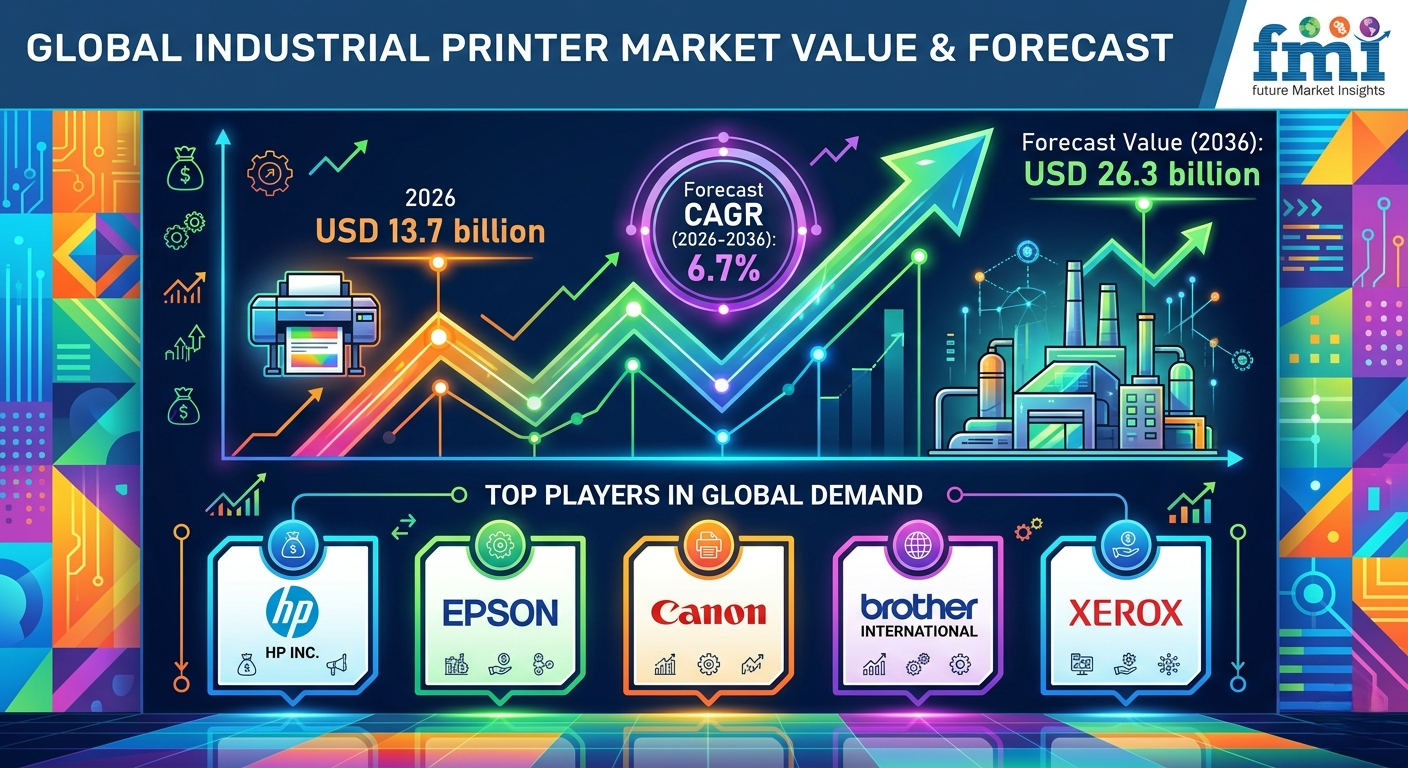
Industrial Printer Market Growth
Industrial printer demand is rising as manufacturers adopt high-speed printing for labeling and traceability, ensuring compliance and production continuity.
NEWARK, DE, UNITED STATES, April 2, 2026 /EINPresswire.com/ -- The global industrial printer market is entering a sustained growth phase driven by manufacturing automation, traceability regulations, and high-volume production marking requirements. The market is valued at USD 13.7 billion in 2026 and is forecast to reach USD 26.3 billion by 2036, expanding at a CAGR of 6.7% during the forecast period. Growth is closely linked to serialized production, regulatory marking, and supply chain traceability requirements across manufacturing and logistics operations worldwide.
Industrial printers are increasingly becoming essential infrastructure in manufacturing environments where product identification, coding, labeling, and compliance marking are required for shipment approval and regulatory adherence. Market expansion is driven more by operational necessity and production continuity than discretionary equipment upgrades.
Quick Stats: Industrial Printer Market
• Market Value (2026): USD 13.7 billion
• Forecast Value (2036): USD 26.3 billion
• Forecast CAGR (2026–2036): 6.7%
• Leading Technology Type: Inkjet Printing
• Fastest-Growing Countries: China, India, USA, Germany, Japan
• Key Companies: HP Inc., Epson, Canon, Brother International, Xerox
Discover Growth Opportunities in the Market – Get Your Sample Report Now
https://www.futuremarketinsights.com/reports/sample/rep-gb-18290
Market Overview and Industry Context
Industrial printers are widely used across packaging, automotive, electronics, pharmaceuticals, textiles, and logistics industries for marking, coding, labeling, and serialization. Demand is primarily driven by the need for permanent marking, variable data printing, and automated production line integration.
Market revenue formation depends not only on equipment sales but also on recurring consumables such as ink, ribbons, and printheads, making operational continuity and installed base expansion key contributors to long-term market value growth. Spending behavior in the market aligns with production line density, compliance exposure, and output variability, rather than short-term capital expenditure cycles.
However, cost structure constraints such as consumable usage intensity, maintenance downtime risk, and integration complexity within legacy production lines continue to influence purchasing decisions and adoption timelines across industrial facilities.
Why Demand for Industrial Printers Is Growing
Demand for industrial printers is rising due to the increasing need for high-speed, high-quality printing for labeling, coding, and marking across production lines. Manufacturing companies are integrating automated identification systems to support traceability, regulatory compliance, and inventory management.
Industrial printers are capable of printing durable codes and graphics on packaging materials, metals, plastics, and textiles, meeting operational and regulatory specifications. Industries such as automotive, electronics, pharmaceuticals, and consumer goods require reliable marking systems because production continuity and product traceability are critical.
Technology improvements in print resolution, ink chemistry, and system connectivity are also enabling integration with enterprise software systems used for production planning, quality control, and inventory tracking.
Procurement teams increasingly evaluate printers based on:
• Serviceability and maintenance requirements
• Consumable availability
• Total cost of ownership over equipment lifecycle
• Integration capability with existing production systems
• Reliability and uptime performance
The growth of contract manufacturing, customized products, and variable data printing is further increasing demand for industrial printing systems across production environments.
Technology Segment Analysis: Inkjet Printing Leads Market Demand
Among technology types, inkjet printing systems hold approximately 46% of market demand, making them the dominant technology segment. Inkjet printers are widely used because they offer flexibility across different substrates and packaging formats while supporting high-speed variable data printing.
Non-contact printing technology allows inkjet systems to print on uneven surfaces and diverse materials without damaging products. Inkjet systems also support rapid production changeovers and short production runs, which are increasingly common in customized manufacturing and packaging environments.
Other printing technologies such as laser printing, thermal transfer printing, and dot matrix printing serve specialized applications requiring durability, heat resistance, or legacy system compatibility.
Key Technology Insights
• Inkjet printing dominates due to flexibility and speed
• Digital integration supports variable data printing
• Laser and thermal systems serve specialized durability applications
• Technology selection depends on substrate compatibility and maintenance requirements
Application Analysis: Packaging and Labeling Account for Largest Share
Packaging and labeling represent the largest application segment, accounting for approximately 52% of industrial printer demand. High-volume packaging operations require consistent marking, lot coding, expiry dates, barcodes, and traceability information.
Regulatory requirements for product identification and traceability reinforce continuous utilization of industrial printers in packaging lines. Growth in packaged goods production, logistics operations, and e-commerce fulfillment centers is also increasing demand for industrial labeling and coding systems.
Other applications include:
• Textile printing
• Automotive parts marking
• Electronics manufacturing identification
• Pharmaceutical coding
• Direct product marking and decoration
Packaging and labeling remain the primary application because they require continuous high-speed printing and strict compliance marking.
How Traceability and Automation Are Shaping Market Growth
Traceability requirements and production automation are major factors influencing industrial printer adoption globally. Manufacturers require permanent and legible codes for product identification, quality control, and supply chain visibility.
Industrial printers are increasingly integrated with manufacturing execution systems and automated packaging lines to enable real-time data printing and reduce manual errors. Industries such as electronics and automotive rely heavily on non-contact marking systems to avoid damaging components during marking processes.
High uptime expectations and low maintenance interruptions are critical factors in equipment selection, particularly in continuous production environments.
Operating Costs and Technical Constraints Affect Market Scalability
Despite steady growth, several factors influence scalability in the industrial printer market:
• High consumable costs (ink, ribbons, printheads)
• Maintenance downtime risks
• Environmental sensitivity affecting print quality
• Integration challenges with legacy production lines
• Regulatory compliance costs for solvent-based inks
• Skilled technician availability for maintenance
• Equipment qualification and validation requirements
These factors can extend procurement cycles and slow deployment across multi-site manufacturing operations.
Global Demand Outlook and Regional Growth Trends
Demand for industrial printers is expanding globally as manufacturing industries increase focus on automation, traceability, and compliance marking. Growth trends vary by region depending on manufacturing output, regulatory enforcement, and industrial automation adoption.
Industrial Printer Market CAGR by Country
• China – 8.1%
• India – 7.9%
• USA – 7.4%
• Germany – 6.6%
• Japan – 6.2%
China’s growth is driven by large-scale electronics and consumer goods manufacturing and export-oriented production. India’s growth is supported by regulatory enforcement of product coding and expansion of pharmaceutical and packaged food production. The United States market is driven by compliance-driven manufacturing, automation investments, and replacement demand for aging equipment.
Germany’s market growth is influenced by precision manufacturing and Industry 4.0 integration, while Japan’s growth is driven primarily by equipment replacement cycles in a mature industrial base.
Competitive Landscape and Key Industry Participants
The global industrial printer market is competitive, with manufacturers focusing on print quality, reliability, integration capability, and service support networks. Buyers prioritize vendors that offer scalable solutions supporting barcodes, QR codes, and variable data printing integrated with automated production lines.
Key companies operating in the industrial printer market include:
• HP Inc.
• Seiko Epson
• Canon
• Brother International
• Xerox
Competitive differentiation is based on print resolution, system reliability, integration flexibility, consumables efficiency, and industrial service support infrastructure.
Market Outlook
The industrial printer market is expected to grow steadily over the next decade as manufacturing automation, traceability requirements, and packaging industry expansion continue to increase demand for coding, marking, and labeling systems. Market growth will be driven by automation penetration, compliance enforcement, and expansion of packaged goods and logistics industries rather than rapid technological disruption.
Industrial printers will remain critical infrastructure in modern manufacturing environments where product identification, regulatory compliance, and supply chain traceability are essential operational requirements.
Why FMI: https://www.futuremarketinsights.com/why-fmi
Explore More Research Reports by FMI
Wearable Device Packaging Market - https://www.futuremarketinsights.com/reports/wearable-device-packaging-market
Faucet and Tapware Packaging Market - https://www.futuremarketinsights.com/reports/faucet-and-tapware-packaging-market
Cap Liners Market - https://www.futuremarketinsights.com/reports/cap-liner-market
Packaging Foam Market - https://www.futuremarketinsights.com/reports/packaging-foam-market
Metallized Film Market - https://www.futuremarketinsights.com/reports/metalized-films-market
About Future Market Insights (FMI)
Future Market Insights, Inc. (FMI) is an ESOMAR-certified, ISO 9001:2015 market research and consulting organization, trusted by Fortune 500 clients and global enterprises. With operations in the U.S., UK, India, and Dubai, FMI provides data-backed insights and strategic intelligence across 30+ industries and 1200 markets worldwide.
Sudip Saha
Future Market Insights Inc.
+1 347-918-3531
email us here
Legal Disclaimer:
EIN Presswire provides this news content "as is" without warranty of any kind. We do not accept any responsibility or liability for the accuracy, content, images, videos, licenses, completeness, legality, or reliability of the information contained in this article. If you have any complaints or copyright issues related to this article, kindly contact the author above.
