

Cell Counting Market to Reach US$19.4Bn by 2033 | Persistence Market Research
cell counting market
Overview of the cell counting market highlighting trends, drivers, technology advances, applications, regional growth, and competitive landscape.
LONDON, UNITED KINGDOM, January 28, 2026 /EINPresswire.com/ -- The global cell counting market is witnessing steady expansion as demand for accurate, efficient, and high throughput cell analysis continues to rise across healthcare and life sciences. The market is estimated to grow from US$ 11.8 Bn in 2026 to US$ 19.4 Bn by 2033, registering a CAGR of 6.1 percent during the forecast period. Growth is supported by rising diagnostic testing volumes, expanding biomedical research activity, and increasing adoption of automated laboratory technologies worldwide.
Download Your Free Sample & Explore Key Insights: https://www.persistencemarketresearch.com/samples/33176
Market Overview
Cell counting technologies play a critical role in clinical diagnostics, research laboratories, and biopharmaceutical manufacturing. Increasing prevalence of chronic diseases including cancer, hematological disorders, autoimmune conditions, and infectious diseases has significantly raised routine testing requirements, particularly complete blood count and immune profiling assays. Aging populations and greater emphasis on preventive healthcare further strengthen demand. Investments in life sciences research, drug discovery, and bioprocessing, along with expansion of contract research organizations and clinical trials, are reinforcing long term market growth.
Key Growth Drivers
Rising demand for high throughput and reproducible cell analysis is a primary market driver. Automated and image based cell counters, fluorescence detection, artificial intelligence assisted analysis, and digital data integration are improving laboratory accuracy and workflow efficiency. These technologies reduce manual errors, shorten turnaround times, and support scalable operations. Growing adoption of cell based research, including stem cell studies, regenerative medicine, and cell and gene therapy development, is also accelerating market penetration across academic and industrial settings.
Market Restraints
Despite strong growth prospects, the market faces challenges related to high upfront equipment costs and technical complexity. Advanced automated systems require significant capital investment, skilled personnel, and ongoing expenditure for consumables, calibration, and maintenance. Regulatory compliance requirements for diagnostics and pharmaceutical applications add further operational burden. In emerging markets, limited laboratory infrastructure and affordability constraints may slow adoption, while regulatory variability across regions can delay product approvals.
Get Custom Insights Designed for Your Business: https://www.persistencemarketresearch.com/request-customization/33176
Emerging Opportunities
Expanding healthcare and research infrastructure in Asia Pacific, Latin America, and the Middle East is creating substantial growth opportunities. Government funding for biotechnology, genomics, and translational research is increasing adoption of reliable cell counting solutions. Development of compact, user friendly, and fully automated instruments, combined with cloud based data management, is improving accessibility. Rapid expansion of cell and gene therapy manufacturing and biologics production further elevates demand for precise cell quantification tools.
Category Insights
Consumables and accessories dominate the market due to recurring usage across diagnostics, research, and bioprocessing workflows. Complete blood count remains the leading application segment, driven by high routine diagnostic volumes worldwide. Research and academic institutes represent the largest end user group, supported by continuous experimentation cycles, strong research funding, and early adoption of advanced automated systems.
Regional Outlook
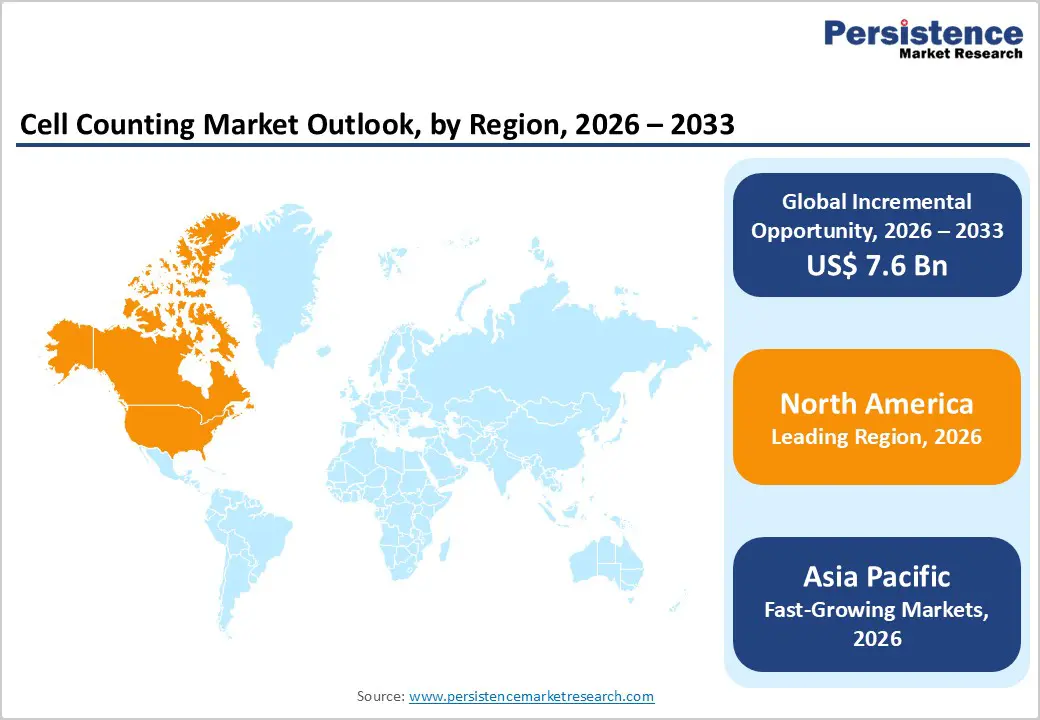
North America holds the largest market share, supported by advanced healthcare infrastructure, high diagnostic testing volumes, strong biomedical research funding, and presence of major life sciences companies. Europe shows steady growth driven by strict regulatory standards, preventive healthcare focus, and expanding biopharmaceutical manufacturing. Asia Pacific is the fastest growing region, benefiting from rising healthcare expenditure, expanding pharmaceutical industries, government backed research initiatives, and improving diagnostic access.
Competitive Landscape
The global cell counting market is highly competitive, with key players including Thermo Fisher Scientific, Merck KGaA, Agilent Technologies, PerkinElmer, BD, and others. Companies focus on automation, analytical precision, regulatory compliance, and workflow integration to strengthen market positioning. Ongoing innovation and strategic collaborations are expected to sustain competitive intensity and long term market expansion.
Checkout Now & Download Complete Market Report: https://www.persistencemarketresearch.com/checkout/33176
Cell Counting Market Segmentation
By Product
Instruments
Hemocytometers
Automated cell counters
Spectrophotometers
Flow Cytometers
Microscopes
Consumables & Accessories
Microplates
Reagents
Others
By Application
Complete Blood Count
Stem Cell Research
Cell Based Therapeutics
Bioprocessing
Toxicology
Others
By End User
Hospitals
Diagnostic Laboratories
Research & Academic Institutes
Pharmaceutical & Biotechnology Companies
Others
By Region
North America
Europe
East Asia
South Asia and Oceania
Latin America
Middle East and Africa
Future Outlook
Looking ahead, the cell counting market is expected to benefit from continued convergence of diagnostics, digital health, and advanced analytics. Increasing emphasis on personalized medicine and precision therapies will drive demand for highly standardized and traceable cell analysis workflows. Manufacturers are likely to prioritize interoperability with laboratory information systems, regulatory ready software, and scalable platforms suitable for decentralized testing environments. Sustainability considerations including reduced reagent consumption, energy efficient instruments, and recyclable consumables may also influence purchasing decisions. As competition intensifies, pricing strategies, service support, and localized manufacturing will play a greater role in customer retention. Overall, strong collaboration between technology providers, healthcare institutions, and research organizations is expected to accelerate innovation, expand application scope, and support resilient growth across global cell counting markets during the forecast horizon and beyond period.
Read Related Reports:
Oncolytic Virus Immunotherapy Market: The oncolytic virus immunotherapy market to reach US$953.3 Mn by 2032, expanding at a 21.4% CAGR amid breakthroughs in cancer treatment and increasing patient demand.
Dural Graft Market: The dural graft market was valued at US$887.2 million in 2025 and is projected to grow at a 5.7% CAGR, reaching US$1,307.8 million by the end of 2032.
Persistence Market Research
Persistence Market Research Pvt Ltd
+1 646-878-6329
email us here
Visit us on social media:
LinkedIn
Instagram
Facebook
YouTube
X
Legal Disclaimer:
EIN Presswire provides this news content "as is" without warranty of any kind. We do not accept any responsibility or liability for the accuracy, content, images, videos, licenses, completeness, legality, or reliability of the information contained in this article. If you have any complaints or copyright issues related to this article, kindly contact the author above.
